(Accounting) Process Automation
Cut down on repetitive tasks and give your team the freedom to focus on work that creates real value
Accounting and process automation
Accounting automation, along with the automation of other processes, reduces the volume of routine work and lets employees concentrate on higher-value tasks.
Routine accounting processes that can be automated include entering data from invoices received by email into your accounting software, tracking payment deadlines and sending reminders, importing bank statements and handling recurring transactions through automated invoicing.
Accounting process automation can be delivered using the built-in functionality of a business management system or by implementing Robotic Process Automation (RPA) solutions.
What is Robotic Process Automation (RPA)?
The replication of repetitive, rules-based tasks performed by a human on a computer using a software robot.
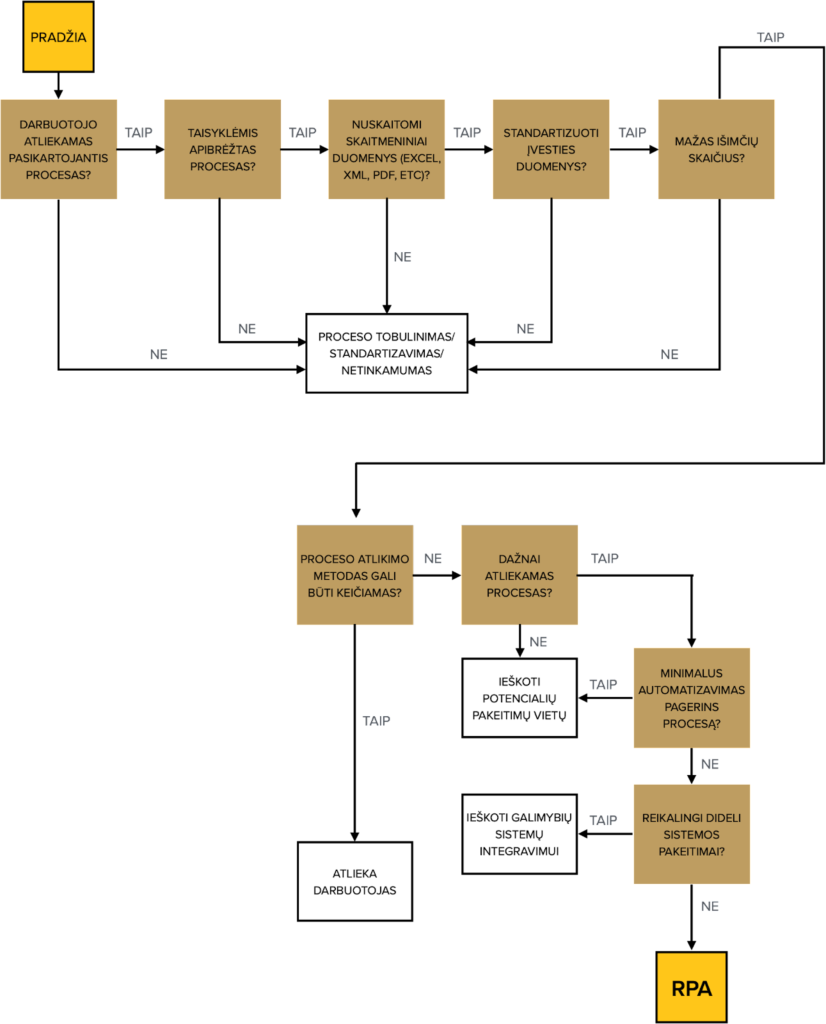
How do we identify what can be automated?
- An employee says that completing the task feels like doing "a robot's job".
- Which tasks does the employee perform more than once a day?
- Are there tasks that need to be carried out outside working hours?
- Are there tasks that involve entering data from one system into another?
- Which tasks most often result in "human error"?
Analysis of potential automation processes (test)
| Characteristic | Rating scale | Points (1-5) |
|---|---|---|
| Is the process rules-based? | 5 = clear rules, 1 = an employee must review every process | |
| Manual and repetitive? | 5 = performed manually and frequently repeated, 1 = rarely repeated | |
| Structured data? | 5 = clearly structured and digitised, 1 = unstructured | |
| Is the input digitised? | 5 = easily readable, 1 = not digitised | |
| Performed frequently? | 5 = performed frequently, 1 = performed rarely | |
| Does the process change often? | 5 = stable process, 1 = changes frequently | |
| Human errors? | 5 = errors occur, 1 = no errors | |
| Is knowledge transferable? | 5 = easily replaceable, 1 = hard to replace | |
| Measurable impact? | 5 = easy to measure, 1 = hard to measure |
36+ Process is suitable for automation
27-35 Process could be suitable for automation
0-26 Process is not suitable for automation
Automation process diagram